Blog
Loading...
Blog

James Turner,
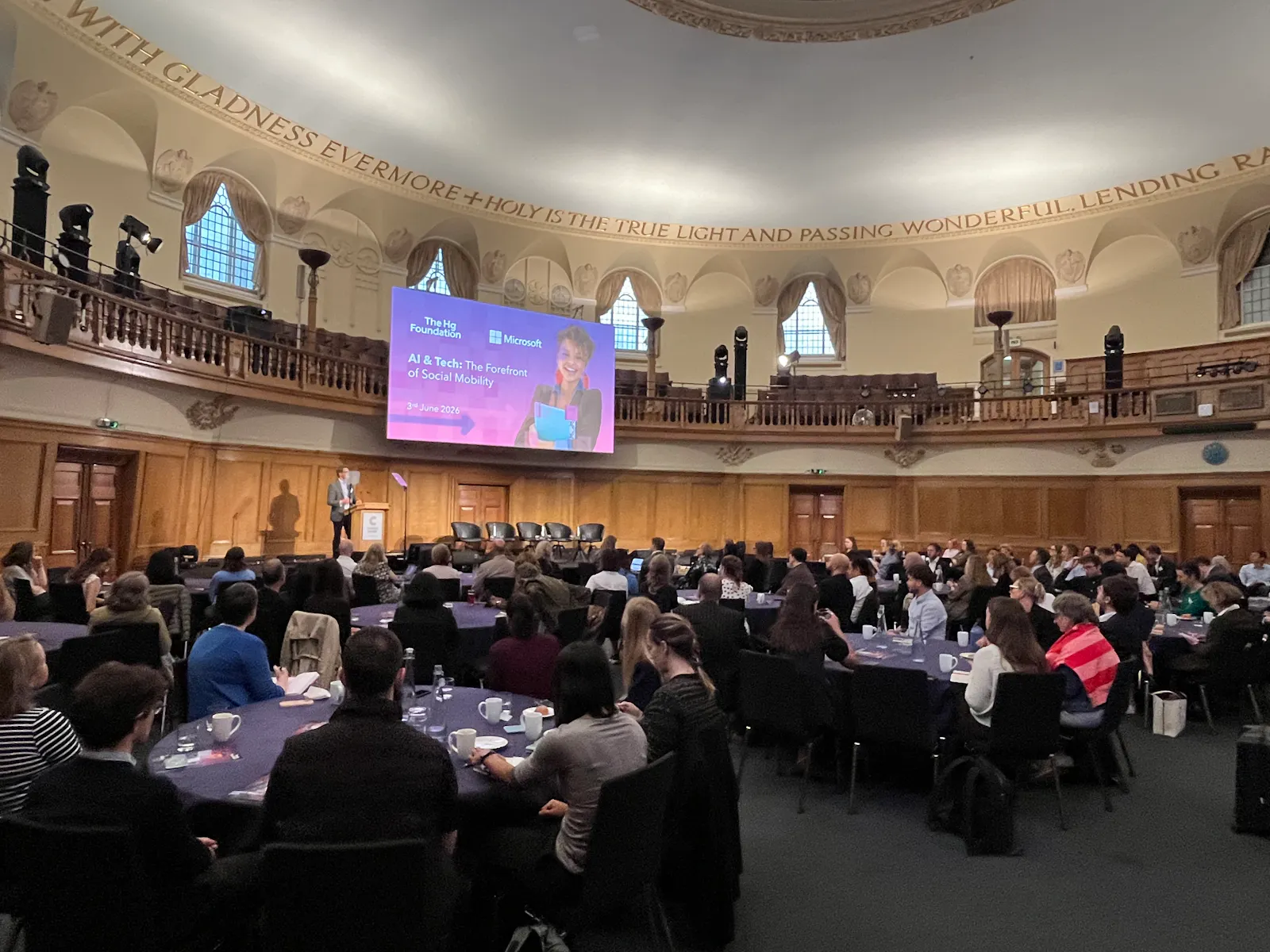
Last week, as rain fell over Westminster, 150 of us gathered in the Assembly Hall at Church House - a venue built for big conversations. Parliament met there during the war, and the Bishops of the Church of England still do.
The conversation The Hg Foundation and Microsoft had convened felt appropriately significant: how AI will affect social mobility, particularly in tech, which is at the forefront of changes to jobs and the skills young people will need.
For those of us interested in extending opportunity, this is the key question to be asking around Social Mobility Day 2026. We are at a crucial juncture for the agenda - in fact, I would argue this is the biggest issue affecting social mobility in my 20 years in the sector.
Almost every week, if not every day, there is another news story about how AI is affecting jobs. These are often negative, especially when it comes to the entry-level roles that have traditionally opened the door to professional careers and well-paid work.
At the same time, technology is creating new opportunities that simply did not exist a year ago, backed by unprecedented financial investment in the companies and products driving this change.
The question is no longer whether AI will affect opportunity, but whether we can shape that change so it widens access rather than narrows it.
However this lands in the medium term (and no one really knows) what is certain is upheaval. And upheaval rarely affects everyone equally. Young people from lower-income backgrounds do not have access to the same advice, guidance, networks or financial cushion as their better-off peers. Every decision carries higher stakes.
That was the unifying concern of everyone gathered at Church House. Darren Hardman, CEO of Microsoft UK, reminded us that we need to translate intent into action: to be deliberate about promoting social mobility as AI gathers pace, from building the talent pipeline early, to rethinking how we hire and assess skills, to equipping those already in work to embrace new technologies. Extending opportunity does not happen by chance.
He and Steve Batchelor, Hg’s Co-CEO, also emphasised that this is not only about fairness; social mobility is a question of competitiveness and economic necessity too. Decades of investment experience show that businesses ultimately succeed because of people. Talent, culture and cognitive diversity matter - and AI adoption will only succeed if those fundamentals are in place.
The world is not short of well-intentioned ideas, but Nick Bent, CEO of upReach, reminded us that action has to be driven by evidence. We have announced our third grant to support upReach’s flagship Tech 500 programme, the largest programme of its kind supporting lower-income undergraduates into tech careers. The programme puts AI proficiency front and centre. Crucially, independent research found that participants are 65% more likely to secure highly skilled full-time employment and 80% more likely to earn above the average graduate salary. In a sector where little evidence exists and resources are tight, we need more studies like this.
Of course, much talent is lost by the time students reach university. Claire Willis of RTC North made the case for earlier intervention and sustained support. We have been working with RTC North and the National Cyber Security Centre on CyberFirst Horizons, to support students aged 16–18 to build skills, get inspired about careers in the sector, and receive practical guidance as they navigate decisions about apprenticeships, university and jobs. This summer CyberFirst Horizons will double in size. In an AI-driven world, cyber careers remain a powerful social mobility opportunity and one that is vital to our national security and prosperity.
Directly supporting students is the Foundation’s bread and butter, but Julia Adamson from BCS outlined how teachers are key to young people’s life chances — even more so at a time of upheaval and for those young people who can rely less on family and network support. Our collaboration with Microsoft and Cognizant to launch BCS’s AI Confidence is an important milestone, providing a series of short, free online modules designed for anyone working in education: teacher, leader, careers adviser, SENCO, administrator or support staff.
We also touched on issues that deserve much deeper attention: FE, vocational and alternative routes into tech; adult reskilling; the fairness risks of AI-enabled hiring; the divide opening up between free and paid-for AI tools; and the capabilities underrepresented groups will need to engage confidently and fluently with AI.
The conversation did not shy away from the risks AI poses to social mobility. They are real and already visible. But I found two things heartening.
The first was our panellist, Najmah: a Tech500 graduate now working in software at Microsoft, doing incredible things professionally and the best advert for the importance of this work. With people like Najmah at the helm, the future is in good hands.
The second was the openness of those gathered to work together. The social mobility sector too often feels like a competition for resources and profile, but I heard many conversations between people wanting to join up their programmes, share resources and compare notes on approaches. For our part, partnership is at the heart of what we do and the projects we spotlighted last week are just a snapshot of how we support social mobility in tech through others. But there are dozens of other organisations beyond our portfolio doing excellent work too.
That rich ecosystem matters because there is no single answer to keeping social mobility at the centre of AI developments. But doing nothing is not an option — and waiting for a perfect plan means falling behind. The task now is to get on with the hard yards: supporting young people well, staying responsive as the technology changes, and continuing the conversations and partnerships that can indeed turn intent into action.
James Turner