Blog
Loading...
Blog

Gemma Collins,

AI is creating new, well-paid careers in tech, but fewer ways in for young people. On 19th October, The Hg Foundation, with the support of JPMorganChase, launched the AI & Economic Opportunity Fund to help change that. The Fund is a £3.4 million, three-year initiative to widen access to high-quality tech careers for low-income young adults without degrees in the UK.
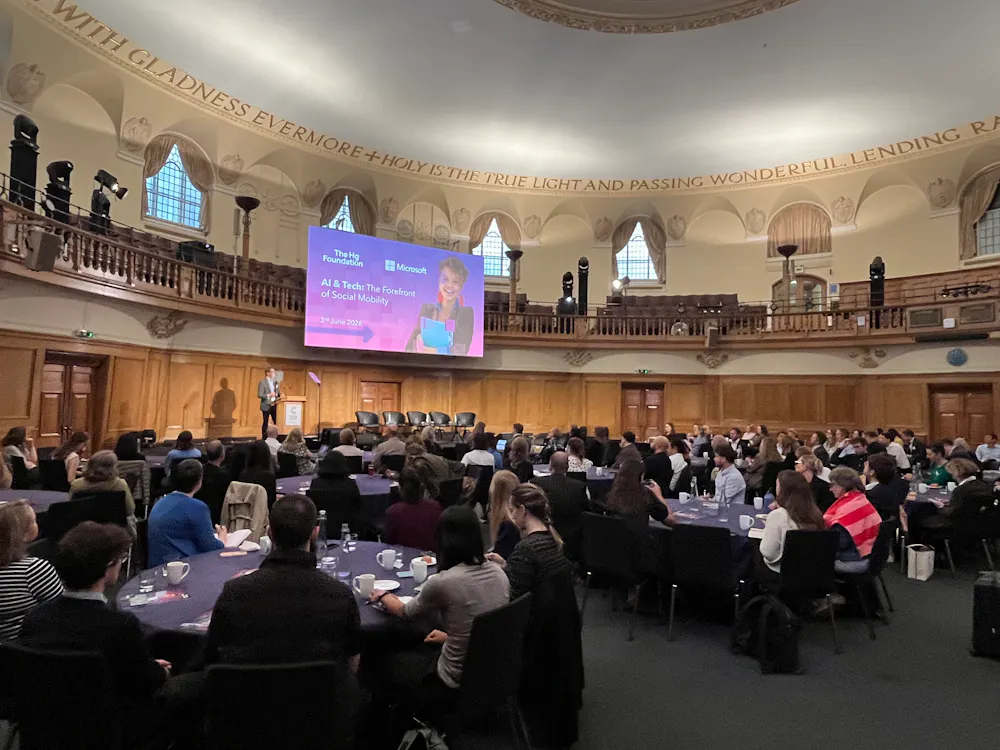
On the same day, we opened applications for our Programmes Fund and published our first Tech Labour Market Briefing. We marked the occasion with 115+ employers, training providers, policymakers and young people at J.P. Morgan’s Great Hall in London.
The briefing, based on Lightcast and PF Global’s analysis of more than 70 million UK job adverts, shows a sector that still pays well but is harder to break into. The average advertised tech salary is around 60% above the UK average, yet entry-level tech adverts have roughly halved since 2019–20 as hiring tilts towards experienced staff.
But we also found real cause for optimism. Almost half (49%) of entry-level tech roles that state an education requirement are open to people without a degree, and their number grew 7% in the past year. Employers want a blend of skills, with communication, problem solving and AI literacy alongside technical know-how. Young people want in, too. Digital apprenticeship starts have more than doubled in four years to over 31,000. As our CEO James Turner wrote in FE Week, “The appetite is there. The challenge is making sure there are first-rung jobs waiting at the end.”
Widening access cannot rely on training alone, so the Fund brings programmes, employers, funders and policymakers together. Our Programmes Fund will back delivery programmes with grants of up to £500,000 over two years, reaching around 900 young people aged 16 to 30. Programmes will pair AI-relevant skills with the work experience, mentoring and employer connections young people need to get hired. Our goal is that many will move into tech employment or a high-quality apprenticeship within 12 months of completing, and every programme will be independently evaluated. Our Intelligence Hub will keep tracking how AI is reshaping entry routes, and our Impact and Learning strand will share what works with providers, employers and policymakers. We were delighted that AI Minister Kanishka Narayan welcomed both the report and the Fund.
Our launch panel, chaired by our Trustee Sam McGonigle, brought the evidence to life. Laura Foster from Microsoft offered a new way of thinking about careers: “It’s less like a career ladder, more like a career mosaic,” built from part-time jobs, online credentials and learning on the job. Michael Elliott of JPMorganChase described a shift in what employers value, away from narrow technical expertise and towards systems thinking and understanding customer needs. Germán Bencci, Founder and CEO of training provider Code Your Future, encouraged learners to apply even when a job spec asks for a degree. Like Jonathan Simons from PF Global who walked us through the research, Germán also urged employers to be clear about what they need from young talent, so providers can target developing those skills and “create a learn to learn, inquisitive mindset.”
We also heard from two individuals who have built tech careers through non-degree routes. Deago Browne, a Code Your Future alumnus now working at Capgemini, said: “Young people have skills but don’t recognise they do, so it’s key that we provide opportunities so that they can practise and build confidence in the skills they have already got, and develop new ones.” Elijah Adeyemi, a Data Apprentice at JPMorganChase, described how work experience helped him stand out and how his mentor opened doors for him. His advice was simple: “Your network is your net worth.” Many of the young people the Fund is designed to supports don’t yet have that network and can’t build it alone – which is why we set up the Fund. When programmes connect young people with employers offering work experience, mentoring and interviews, potential becomes a first job and the sector builds the talent it will need next.
None of this would be possible without JPMorganChase. Thank you for your funding and expertise, and for hosting our launch. We are also grateful to our Employer Advisory Panel, who have shaped the Fund and kept it grounded in the tech sector’s changing skills and hiring needs.
There are three ways to get involved.
1. If you want to understand how AI is reshaping entry-level routes into tech, whether as an employer, training provider, policymaker or researcher, read the full Tech Labour Market Briefing. We will publish new research every six months.
2. If you run a programme that has a proven tracked record in supporting low-income young people without degrees into tech jobs or apprenticeships, we welcome your application. Applications close at 9am on Monday 23rd November 2026. The prospectus, application form, FAQs and a recording of our recent overview webinar are on our Programmes Fund page.
3. If you are an employer or policymaker, you are central to what we want to achieve, and we want the Fund to build on the good work already happening. Employers can offer young people on funded programmes work experience, mentoring and hiring opportunities. Policymakers can use our evidence to help keep non-graduate routes into tech open. If you have relevant work to share, want to get involved or would like to hear from us as the Fund develops, register your interest via this form.
Tech can be one of the UK’s clearest routes to social mobility. Through the Fund, we hope to make sure the first rung is within reach for every young person with the talent to climb, and we look forward to sharing our progress over the next three years.
Gemma Collins
Gemma is one of the Foundation’s Portfolio Leads and leads on a portfolio of our employability partnerships, primarily those in the UK and Europe. Gemma joined The Hg Foundation in September 2023. Prior to joining the Foundation, Gemma was a Senior Programme Manager at The Sutton Trust, a UK social mobility charity where she managed employability and work experience programmes for 16-18 year olds. Gemma studied History at Harvard University and has stayed engaged with the university as an alumni volunteer interviewer and previously as a Trustee for the Harvard Club of the UK. She now lives in the North West of the UK with her partner, two young children, and dog. Outside of work and family life, she serves as a Governor for a local primary school (the school she used to attend) and also volunteers for Girlguiding as a Treasurer (and was formerly a Brownies leader).